
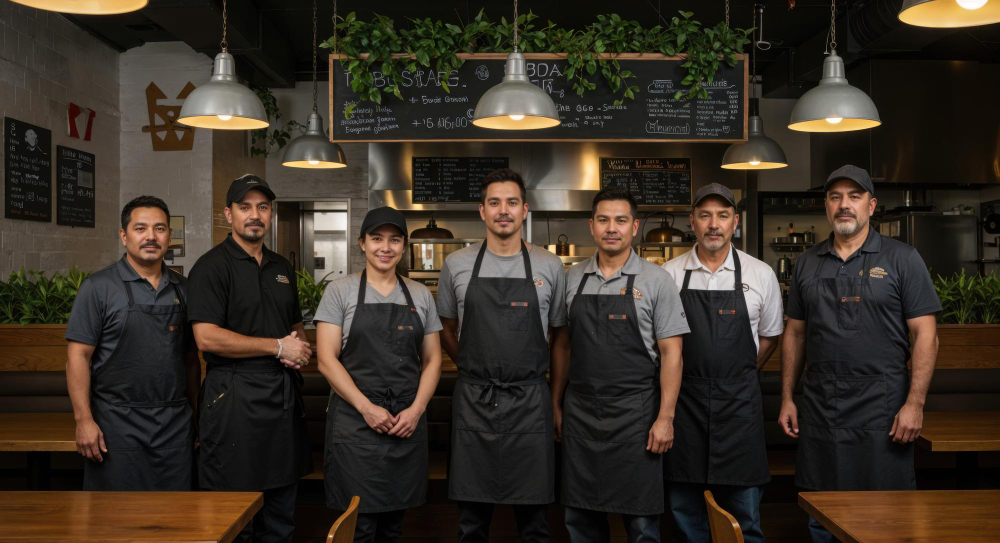
Point-of-sale spending in Saudi Arabia’s accommodation and food services sector reached SAR 21.0 billion in July 2026, up 13.5% year on year, across 102,333 active establishments employing 716,653 insured workers. The sector also records one of the Kingdom’s longest working weeks — 50.7 hours on average, per the most recent measurement from the Ministry of Economy and Planning.
The constraint is not hours worked. It is productive hours. Choosing restaurant workers well decides whether a branch turns 40 tables at peak or 25 with the same headcount and the same floor space.
What Are the Responsibilities of Restaurant Workers?
Define the station before you look for the person. Front-of-house shortens time-to-first-contact. Kitchen preparation holds portion control, stabilising taste and cutting waste. Pass and packing verifies orders before they leave, which is decisive for delivery returns. Floor and cleaning turn tables faster, raising covers per hour. Judged this way, a candidate is measured against numbers, not impressions.
Key Skills Every Restaurant Worker Should Have
Capability shows in the busiest hour, not the quiet ones. Test five things before contracting:
- Recovery under error — handling a delayed order or an unhappy guest. This alone protects your ratings on delivery apps and maps.
- Peak awareness — noticing the room shift from calm to full and re-prioritising unprompted.
- Standardised recipes — same portion, same method, every time, protecting both repeat custom and food cost.
- Kitchen-to-floor communication — most delays come from weak handoffs, not slow cooking.
- Food safety — temperature control, separation of raw and ready foods, hygiene.
All five can be verified by video interview or short practical test before arrival.
Saudization Requirements for Restaurants and Cafés
Rates differ by activity and location, and this is where most operators miscalculate. Restaurants with table service, banquet kitchens, fast-food outlets and juice shops carry 20% in standalone or mixed premises, rising to 40% inside enclosed malls, applied at four or more workers per shift. Cafés and ice-cream shops carry 30% standalone and 50% inside enclosed malls — and the trigger is two workers per shift, which captures nearly every independent café in the Kingdom. Mobile units are at 100%.
The Ministry exempts specific activities: catering and food supply contractors, canteens inside factories, offices, hospitals and schools, and restaurants and cafés inside hotels.
Requirements for Recruiting Restaurant Workers in Saudi Arabia
Two ministry programmes sit ahead of arrival. Professional Verification covers 160 countries as of January 2025 under Cabinet Decision No. 195, targeting high-skill occupations against the Saudi Standard Classification of Occupations. Professional Examination covers medium and low-skill roles through practical and theoretical testing at more than 127 centres inside and outside the Kingdom. Add food-handler health certificates, documented contracts and compliant accommodation. Getting this wrong stalls expansion, not just the budget.
Restaurant Staffing: Recruitment or Temporary Hiring?
Demand is not a straight line: two daily peaks, Ramadan, school holidays, city events. Staff to the peak and you pay wages through empty hours; staff to the average and you lose sales.
The workable structure is a fixed core plus a flexible layer. The core, roughly 60–70% of the team, covers stations needing accumulated product knowledge; the flexible layer absorbs seasons and sudden absence through seasonal staffing solutions. Labour shifts from a fixed cost to one that moves with revenue.
Case Study: Closing a Capability Gap Without Adding Headcount
Americana Restaurants operates 2,590 restaurants across 12 countries, including 734 in Saudi Arabia at the end of 2024, with 38,630 employees. Its 2024 annual report states the problem plainly: store count was growing, but no structured programme existed to develop Restaurant General Managers into Area Coaches, forcing reliance on external hires. The answer was not more hiring but developing the people already there. The Grow programme, launched in October 2023, was attended by 86 high-potential managers, and 12 training champions were prepared to deliver it across four markets. In the same year, the company reported lower attrition: full-time turnover of 9.3% against 9.8%, and part-time of 33.3% against 36.8%.
What to Expect From a Workforce Partner
Three questions separate a headcount supplier from a workforce partner. Who carries the compliance burden? Who guarantees readiness on day one? Who covers sudden absence in hours, not weeks? Contract against measurable indicators: time to cover, replacement rate, retention at 90 days.
Common Restaurant Staffing Challenges and How SMASCO Solves Them
Sudden absence at peak needs a trained substitute within hours. Long procedures need a specialist handling verification, contracts and housing. Seasonal swings need contracts that expand and contract.
SMASCO for Workforce Solutions serves hospitality among its target sectors, providing restaurant workers who meet regulatory requirements, on permanent or seasonal contracts sized to your operation. For the wider commercial case, see how quality staff protects your profit margins.
FAQs
Are restaurant workers counted in the Saudization ratio?
Yes, toward total employees at the establishment, unless classified under the occupations exempted in the procedural guide.
What Saudization rate applies to my outlet?
20% for restaurants in standalone or mixed premises and 40% inside enclosed malls; 30% and 50% respectively for cafés, applied from two workers per shift.
Can I combine Saudization compliance with expatriate restaurant workers?
Yes, and it is the standard model. Ratios are calculated by establishment and occupation, so design the structure before hiring.
Sources
- Accommodation and Food Service Activities — DataSaudi, Ministry of Economy and Planning.
- Localisation decisions for restaurants, cafés and central supply markets — Ministry of Human Resources and Social Development.
- MHRSD completes Professional Verification service across 160 countries — Saudi Press Agency, 20 January 2025.
- Professional Accreditation and Professional Examination programme — Ministry of Human Resources and Social Development.
- Integrated Annual Report 2024, pp. 50–53 — Americana Restaurants International PLC.