

E-commerce has fundamentally changed the rules of the game in many sectors, but it was the logistics services that have undergone a massive transformation with this growth. Logistics services became an integral part of consumers’ daily lifestyle, from the moment a product leaves the warehouse, to arriving at the store, and to delivering to the consumer’s place accurately, quickly and efficiently. Here we will review the impact of this growth, and how the Kingdom is reshaping it to participate significantly in the Saudi GDP.
The boom that e-commerce caused for the logistics services
It’s expected for the global e-commerce sales to reach a staggering $7 trillion by 2025, this unprecedented growth has led to a significant turnaround in the retail sector, and has also had a great impact on the logistics services.
With every successful experience in online shopping, e-commerce expands, and the need for effective and reliable logistics solutions increases exponentially. The success of e-commerce heavily depends on the ability for companies to deliver orders quickly and accurately; and this is how logistics services play a critical role in this success. Afetrall, it puts a great pressure on logistics companies to adapt and innovate to meet the growing needs of different consumers.
The impact of this boom on the logistics services workforce
E-commerce has also affected the workforce in logistics services, as new roles emerged and new skills been required. Now vacants are always open in the areas of delivery services, warehouse operations, and customer service; logistics services companies lately hired data processing professionals also, software engineers, and UX designers to develop and manage the new systems.
Workforce shortage has always been a challenge in logistics services
Many jobs are gradually localized in the Saudi’s logistics services within the framework of Vision 2030, as the government seeks to reduce dependence on migrant workers and increase Saudis participation in this sector. However, there are some professions difficult to localize fully or directly.
As an example, in Saudi there is a severe shortage of truck drivers, which is also a difficult job to localize due to the large number of skilled workers required. And this is one reason Saudi Arabia heavily depends on immigrants in this profession.
You can now seek advice from SMASCO for hiring professional truck drivers, trained on the roads in Saudi, legally covered, and adherent to the Saudi traffic rules. SMASCO trains these truck drivers, completes all the necessary procedures for them to obtain work permits and driving licenses, and gives you access for an easy and effortless hiring process. Connect with the SMASCO team now.
With its ambitious plans, Saudi intends to become a global logistics center
The logistics outline includes 59 centres covering an area of more than 100 million square meters. This includes 12 centres in the Riyadh region, and 12 centres in the Makkah region, as well as 17 centres in the Eastern Region and 18 centres in the rest of the Kingdom. Currently, 21 centres are being set up, and all centres are expected to be completed by 2030.
These centres will contribute to enabling local industries to export Saudi products efficiently and promote e-commerce by connecting logistics centres and distribution zones in different regions, cities and governorates. In addition, these centres will provide an advanced system for tracking shipments and facilitating procedures for obtaining licenses for logistics services.
The license was granted to more than 1,500 local, regional and global companies, especially after the launch of the Consolidated Logistics Licence, as well as the Two-Hour Clearance Initiative in collaboration with the relevant government authorities in Saudi.
It is also planned for 69 logistics platforms to be developed, spread over 27 logistics zones, 8 zones on the land outlets, and 9 zones dedicated to truck parking, to achieve the highest efficiency and better utilization of resources.
In addition, 3 logistics areas at Riyadh, Jeddah and Dammam airports will accommodate about 4-5 million tons per year of air cargo. While in the ports of Jeddah, King Abdullah and King Abdulaziz, three logistics areas will handle 14 million containers, contributing significantly to the support of the exportation, importation and re-exportation.
The government’s developing efforts are aimed at transforming the Kingdom into a global logistics centre; Saleh Al-Zweid, the official spokesman of the Transport General Authority, mentioned a signing of 30 agreements with the private sector to support bus drivers and heavy transport vehicles. He also explained the existence of numerous agreements, incentives and support for companies and citizens in this sector, such as the Human Resources Fund “HADAF” (i.e goal), which provides financial support of up to SAR 2,400 for workers in passenger apps, and SAR 3,000 for those in order delivery apps.
Programs for supporting local and international companies and motivating logistics workers in the Kingdom
Government initiatives point to the Kingdom’s commitment to integrate logistics services with various transport systems, by supporting local and international companies. Several incentive programs have been launched for workers in the sector, including financial support for citizens working in order to deliver orders and passenger applications.
Companies that want to enter the Saudi market, or expand their operations, can therefore benefit greatly from ongoing improvements in the logistics sector, infrastructure developments and government support, which make the Kingdom an ideal environment for investment in this promising sector.
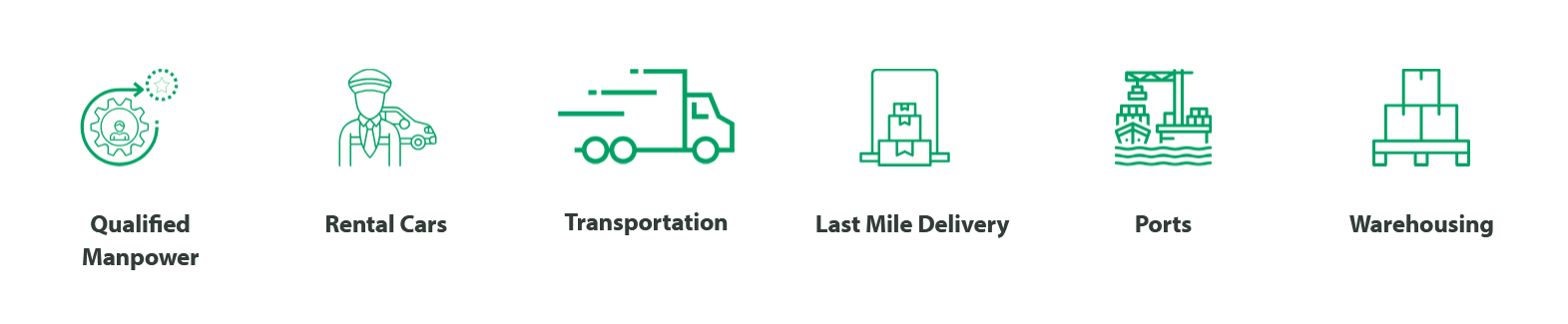
The fields SMASCO provides with skilled logistics workers … and more
Success partners of SMASCO for whom we have provided qualified and professional logistics workers
Conclusion:
The National Transport and Logistics Strategy aims to reach many of the planned objectives in the logistics sector and move towards integration and coherence in the transport and logistics system, within the objectives of the Kingdom’s Vision 2030.
The governmental efforts aspire to transform Saudi Arabia into a global logistics hub by 2030. This includes expanding infrastructure, reducing the number of platforms and focusing on high efficiency, thus enhancing the Kingdom’s position on the global map. If you are seeking to contribute to this development or looking for advanced logistics solutions, this time is best suited to take a serious and bold step to take advantage of the golden opportunities offered by the Saudi market.
SMASCO supports your business with its expertise in providing different types of logistics workers
Do you wish to participate in this transformation in the Kingdom’s logistics industry? For a free consultation regarding your requirements for skilled logistics workers that can greatly contribute to your success in the Saudi market, contact the SMASCO team of experts today.
Sources
- An overview over logistic services sector (نظرة عامة على قطاع الخدمات اللوجستية), Ministry of Transport and Logistic Services, Saudi.
- The logistic platform, Ministry of Transport and Logistic Services, Saudi.
- Logistics Force in Saudi Arabia.. Excellence and sustainability (القوة اللوجستية في السعودية .. التميز والاستدامة), September 1st, 2023, alarabiya.net.
- Impact of E-commerce On Logistics and Transportation, Er Sudharsan, April 13, 2023, LinkedIn.
- The Impact of E-commerce on Logistics: Adapting to Consumer Demands, April 29 2024, TCItransportation.com.